Plastic Pallet Production Line Tested on Waste Film and Pallet Scrap
In October 2026, a customer from Russia visited the PalletMach factory for the on-site acceptance test of a custom-built plastic pallet production line. Two different waste plastics ran on the same line – waste film and worn-out pallets. Both streams were prepared, blended and pressed into moulded pallets while the customer watched. The output met the customer's expectations, and the line is now scheduled for shipment.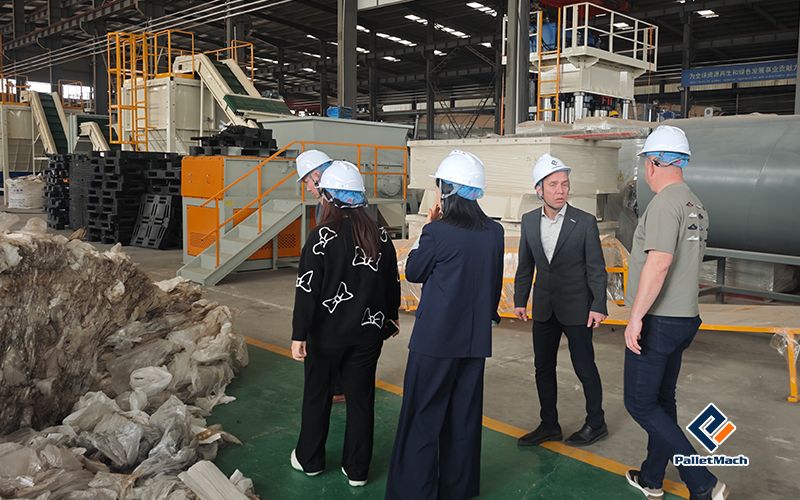
1. Two waste streams, two different problems
The customer's plant generates two plastic waste streams that behave very differently.
- Waste plastic film is light and bulky. It takes up storage space, it is awkward to feed into equipment, and it can hold moisture. If damp film reaches a press, the moisture flashes into steam inside the mould. The result is a porous, weak pallet with no load capacity to sell.
- Worn-out plastic pallets are the opposite case: rigid, thick and dense, with a different melting behaviour from film. Crush them the same way as film and the line feeds unevenly.
Neither stream is difficult on its own. The difficulty is combining them. If both materials are simply tipped into one crusher and fed forward as they are, the press receives an inconsistent material, and pallet quality becomes a matter of luck. That question – what exactly is arriving at the press – opens every waste plastic pallet machine project we have written about, and it decided the design of this line as well.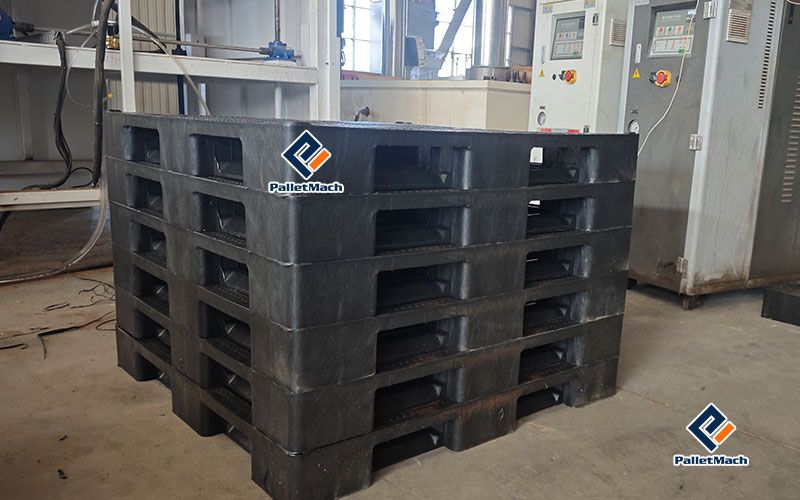
2. Pretreatment first, mixing second
The line therefore handles the two streams separately before they ever meet:
- The film passes through shredding, crushing and dewatering. The dewatering step squeezes out moisture, so the material arrives at the next stage dry, dense and steady enough to feed.
- The old pallets are crushed on a separate path, sized for the extruder rather than for storage.
Only after both streams are prepared are they blended at a set ratio and fed into the line continuously. The order is not cosmetic. Once two materials are mixed, they can no longer be treated differently – so every correction has to happen before mixing, not after.
One detail worth noting is the difference between mechanical dewatering and thermal drying. Squeezing the water out of film costs a fraction of the energy a hot-drying stage would need, and it does it at line speed. For a recycler whose margin is the difference between waste disposal fees and pallet sales, that energy saving is not a detail – it is part of the business case.
There is no pelletising step anywhere on this line. Crushed, cleaned material is melted by the plastic recycling extruder machine and pressed directly into the mould. For a recycling company, that removes an entire investment stage: no granulation line to buy, power and maintain between the crusher and the press.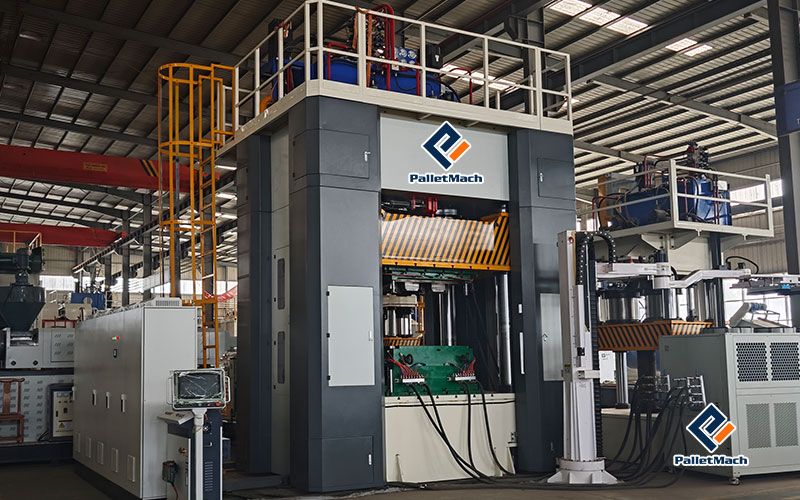
3. What the customer checked before accepting
An acceptance test is not a demonstration. The customer walked the line while it was running, checked the operating state of each unit, and went through the process logic from feeding to demoulding. The plastic pallet moulding machine in this class is rated at 20 pallets per hour, with actual output depending on the mould and on the material mix being fed.
What comes out of the mould is a one-piece moulded plastic pallet, not an assembled one: the melted material fills the cavity under pressure and sets as a single piece. That is where the load capacity and dimensional stability come from – there are no connectors, nails or weld lines to fail.
The customer confirmed that the output met expectations and accepted the test result. The next step is shipment and installation at the customer's site, where the line will support a local plastic recycling project.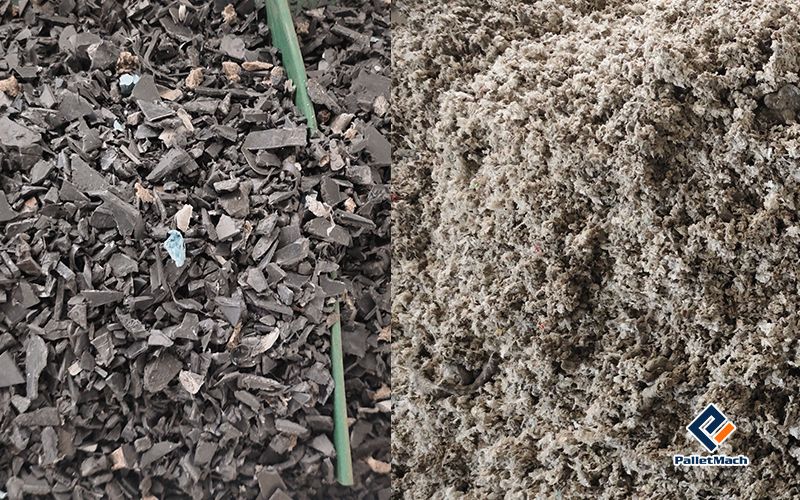
4. Send your material before you discuss a price
The sequence this project followed is the sequence we recommend to every recycler:
- Send us a sample of your waste plastic.
- We run it on the plastic pallet making machine at our factory, adjusting pretreatment and pressing parameters until the pallet comes out right.
- You receive the test result – what went in, what came out, and what had to be adjusted.
- Only then do we quote a line configured for your material.
A quotation built on an untested assumption is worth exactly what it costs. The test costs you a courier parcel.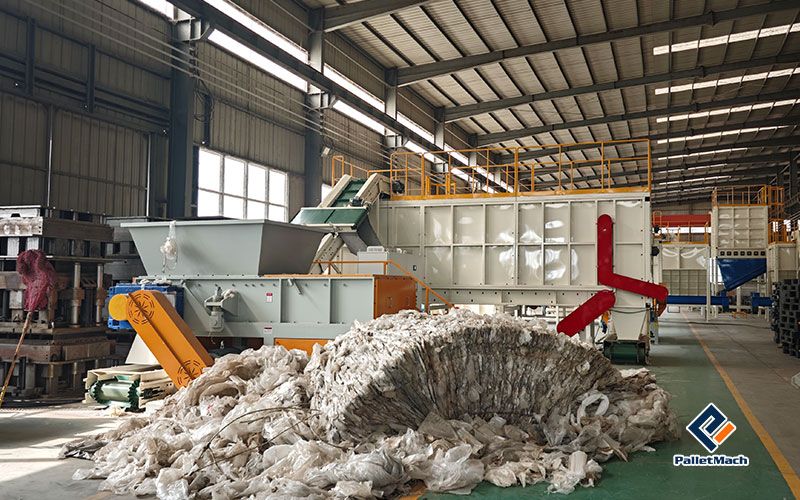
5. What we actually deliver
A plastic pallet production line is not one machine. It is a pretreatment plan for your specific waste, a pressing process matched to it, the line itself, operator training and follow-up after installation. The press is the part you can photograph. The pretreatment plan is the part that decides whether the pallets still come out right on day 300.
That is what this customer from Russia is taking home: not a press, but a working route from two waste streams to a saleable pallet – the same route their own waste is about to follow.
Can the line take mixed waste plastic without pelletising?
Yes. Compression moulding works on crushed, cleaned material: the extruder melts it and the press forms it directly, with no granulation stage between crushing and pressing. What matters is that each stream is prepared correctly before blending – which is exactly what the pretreatment section of the line is for.
How do I know whether my own waste plastic will work?
Send a sample. We test it, adjust the pretreatment and pressing parameters, and send you the result before any quotation. It is the same procedure this project followed.
Contact PalletMach Equipment
Email: [email protected]
WhatsApp / Mobile: +86-13733828553
Office: +86-21-80392223
Address: Room C3072, Building 24, No.2 Xincheng Road, Nicheng Town, Pudong District, Shanghai, China
Website: www.palletmach.com
Products
-
 Wood Pallet Machine
-
 Plastic Pallet Machine
-
 Pallet Block Machine
-
 Auxiliary Equipment
Solution
-

Vertical palletizing robot
The vertical palletizing robot is a kind of palletizing equipment with a compact structure and small footprint. The vertical palletizing robot has a simple operating principle and is easy to operate. It is suitable for palletizing various small goods. Pal...
-

Automatic Compressed Plastic Pallet Production Line
The plastic pallet production line mainly uses various materials of waste plastic to produce plastic pallets. Plastic pallet production line includes conveying device, plastic extruder machine, plastic pallet molding machine, robotic arm, etc. The conveyo...
-

Semi-Auto Wood Pallet Production Line
PalletMach independently developed and designed the wood pallet production line for string pallet or EPAL pallet, this line has advantages of flexible size adjustment, low investment, high efficiency, simple structure, easy maintenance, labor saving, etc....
-

coco husk pallet production test successfully
PalletMach has tested coco husk pallet with molded pallet machine successfully today. Coco husk pallet is a sustainable alternative to existing wood and plastic pallets....