Canton Fair Day Two: Compressed Wood Pallet Machine Draws Buyers
The 140th Canton Fair runs in Guangzhou from 15 to 19 October 2026. Day two at our stand in Area D, Hall 19.1, and the pattern was already set: buyers walked in with their phones instead of brochures. A photo of a sawdust pile, a video walking through a yard of plywood offcuts, a screenshot of a warehouse full of material nobody knows what to do with.
Nobody Could Bring the Material. Everybody Brought Photos of It
The first question of the day was almost always the same, and it never mentioned price: can this be made into a pallet?
Across two days the screens filled up with the same short list. Wood side: waste wood, sawdust, wood chips and shavings, plywood offcuts and waste veneer, logs, planks, branches and slabs. Fibre side: wheat straw and corn stalk, waste kraft paper, waste paper, bamboo, palm, coconut husk and coir, bagasse and miscanthus. Plastic side: PP, PE and PVC, plus film, crates, pipe and mixed or dirty scrap. Two visitors also showed photos of cable skin and paper mill residue and asked whether those could be pressed as well.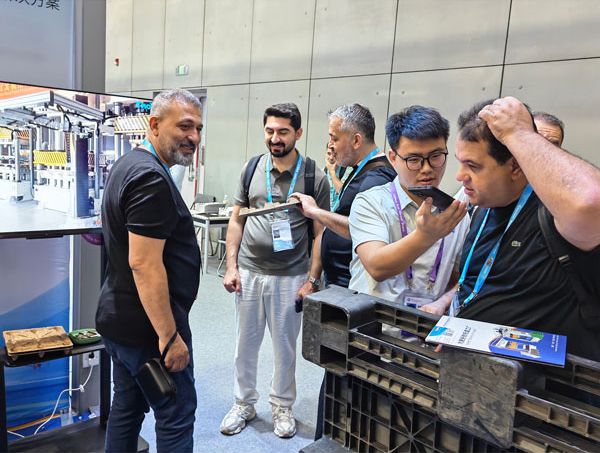
Part of that list sits inside our standard raw material range. Part of it does not - and that gap is exactly why a sample has to be tested before anyone talks about a machine.
The Compressed Wood Pallet Machine: Wood Waste In, a Moulded Pallet Out
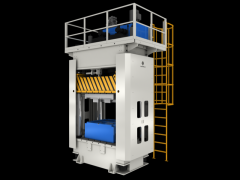
Waste wood is the most common case at the fair. A sawdust pallet machine presses sawdust, wood chips and shavings, waste pallets, logs, planks, branches, wood board and the offcut left over from plywood production - the same machine every time. A buyer who spends the day hunting for a compressed wood pallet machine ends up choosing between moulds rather than between machine types: the mould decides the pallet, the frame only delivers the force.
Explaining the presswood line: mould, moulds and load.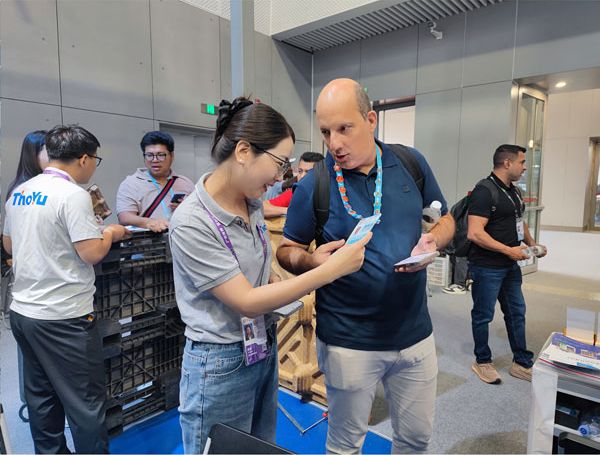
Because the pallet is pressed in a closed, heated mould - no nails, no chemical treatment - it comes out non-hygroscopic and dimensionally stable, and the same line works as a fumigation free pallet making machine for export under ISPM 15. Fibre goes further than wood alone: straw, waste kraft paper, waste paper, bamboo, palm, coconut husk and coir, softwood, bagasse and miscanthus all run here.
What most buyers are actually building is not one press but a line: chipping, crushing, drying, glue mixing and pressing, with a mould temperature controller holding the cycle, available semi-automatic or fully automatic. The gap between a line that runs and a line that stalls is almost always the material preparation in front of the press - which makes the press itself only one decision among several.
The Plastic Pallet Machine: Mixed Waste Plastic In, a One-Piece Pallet Out
The second line answers a different problem. Recycled plastic arrives as film, crates, pipe, sheet, packaging and mixed or contaminated material that has no second life in its current form. Our plastic pallet moulding machine takes waste plastic, PP, PE and PVC: the material is washed, shredded and dried, melted in the extruder and pressed into a single-piece pallet in a closed mould.
Reviewing photos of mixed waste plastic with a buyer.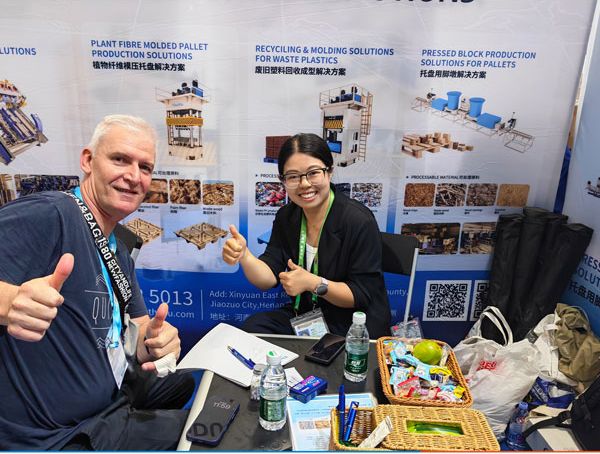
The same press with a different mould also produces plastic boards and other pressed products, which keeps the machine working when pallet orders are quiet. And where the material is a plastic question rather than a wood one - dirty film, mixed polymer, cable scrap - the plastic waste pallet machine is what we would test it on.
How We Decide: A Photo First, a Sample Second
This is the part buyers appreciated most, because it is the opposite of what they expect at a trade fair. The sequence is the same for every material:
- Show us the material. Photos or a short video, and what it is. If you know the mix ratio, tell us that too.
- We tell you whether it is worth testing. On the spot if you are at the booth, by email if you are not.
- Send a sample to the factory. Only if the picture says the material has a chance.
- Our engineers run it - not on paper, on the press. They record how it forms, whether it delaminates, what the moisture does to the cycle, and where the load fails.
- You get a straight answer. Either the material fits a standard recipe, or it needs a formula built around it. Sometimes the answer is that this material should not go into pallet production at all.
None of this is charged. Evaluation and test report come first. Quotation comes after, and only if the material works.
Three Days Left: Bring Your Photos to Area D, Hall 19.1, Booth N01
Phase I of the 140th Canton Fair runs until 19 October 2026, so three days remain. If you are in Guangzhou, bring the photos on your phone to the booth - or simply describe the material, and we will tell you on the spot whether it is worth a test. If you are not in Guangzhou, send a sample to the factory and the same engineers will run it and tell you what it can become.
PalletMach has been supplying pallet machinery and pallet production solutions since 2014. Four lines were on the stand - the compressed wood pallet machine, the moulded plastic pallet machine, the pallet block machine and the pallet nailing machine. What we sell is not only a press: it is the ability to turn material you already pay to dispose of into a product that leaves your yard as stock instead of waste.
Frequently Asked Questions
Can every waste material be pressed into a pallet?
No, and we say so. Fibre-rich material and most recycled plastics press well. Material that is heavily contaminated, or that has neither a fibre structure nor a melt behaviour suited to compression moulding, generally does not - and we will tell you before you spend anything.
What do I need to send for an evaluation?
Photos or a short video of the material first, so we can say whether it is worth testing. If it is, a sample of the material and its composition ratio if you know it. Testing is free and carries no obligation.
Do you also supply pallet block and nailing machines?
Yes. Besides the presswood and plastic pallet machines, we build pallet block machines in single-head, double-head and three-head versions, and pallet nailing machines for stringer and EPAL pallets. Most projects need more than one of them, and the booth is the place to see how they fit together.
Contact PalletMach
Email: [email protected]
WhatsApp / Mobile: +86 137 3382 8553
Website: www.palletmach.com
Products
-
 Wood Pallet Machine
-
 Plastic Pallet Machine
-
 Pallet Block Machine
-
 Auxiliary Equipment