Plastic Waste Pallet Maker Machine: Press Your Own Freight Pallets
You already produce the plastic. Stop paying someone else to take it away.
The short answer
Do you strip cable? Then you are already running a plastics plant — you just do not call it one. Every tonne of copper you recover leaves behind a stream of cable skin: bulky, mixed, and in most developed markets something you pay a licensed operator to take away.
At the same time you buy freight pallets, by the truckload, made from the same family of polymers you just paid to have removed. A plastic waste pallet maker machine closes that loop in your own yard.
1. You are already in the pallet business
Every plant that ships, packs or stores goods buys pallets. Increasingly those pallets are plastic, because plastic pallets survive weather, do not need fumigation and can be washed. You buy them on a schedule you do not fully control, at a price the market sets.
Meanwhile your yard produces plastic every single shift. The only missing step between the two facts is a press.
That is the whole argument, and it is why cable recyclers are the most natural pallet producers in the world: they generate the raw material, they consume the finished article, and both happen at the same address.
2. What is actually costing you money today
Three separate outflows, all of them fed by the same material:
| Outflow | What it really is |
|---|---|
| Disposal fee | You pay a licensed operator to collect and treat the cable skin. In developed markets the fee is the processor’s revenue — you are the customer, not the supplier. |
| Pallet purchase | You then buy pallets made from the same polymer family you just paid to have removed. One material, two payments, in opposite directions. |
| Freight and space | Stripped skin has low bulk density. It occupies volume, handling time and floor space that could hold product. |
None of that is a failure of your operation. It is simply what happens when a material leaves your yard as waste and comes back as a purchased good.
3. “But our material is not clean”
This is the objection we hear most, and it is a fair one. Cable skin is not a single polymer: it is PVC and XLPE, with fibre from the cable core, and a small amount of residual copper that no granulator removes completely.
The reason that matters less than people expect is the process route. Compression moulding is the most impurity-tolerant route in plastics processing, because the compound is melted and pressed into a mould rather than injected through a fine nozzle. There is no pelletising die to protect and no granulate grade to hit. Mixed, partly contaminated material goes into the mould and comes out as a pallet.
Do not assume your stream behaves like someone else’s. The PVC/XLPE ratio, the fibre content and the residual copper vary by source, and those variables decide the blend. We do not guess them. We run your sample and send you the numbers before anyone talks about a purchase order.
4. The two payments that disappear when you press your own
When the skin stops leaving as waste, the disposal outflow stops with it. When the pallets stop being bought, the purchase outflow stops with it. What remains is a pallet pressed from material you already own, sitting on the dock when your own dispatch needs it.
There is a third, quieter gain: supply reliability. Plants that buy pallets are exposed to lead times, price movements and the occasional shortage. Plants that press their own are not.
What we do not promise. We will not quote you a payback period, a profit multiple or a savings figure before your own material has been tested. Anyone who does is guessing with your money.
5. What the line actually looks like
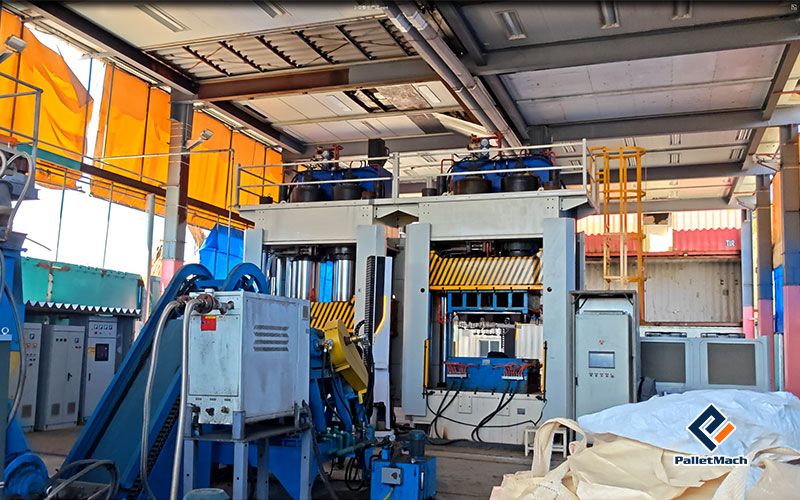
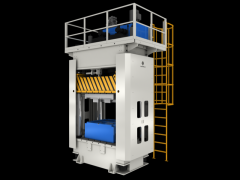
Size reduction comes first: cable skin and PP/PE waste are shredded and reduced to a workable flake. Then mixing and dosing, where the blend ratio is set. The compound is then melted in the extruder and formed in the press under the mould — with the moulds, the hydraulics and the PLC control layer doing the rest. A machine for manufacturing plastic pallets is one component of that chain, not the whole of it — which is why a quotation that lists only a press is a quotation you should question.
Configuration depends on your building. Where floor space is tight, or where output is steady rather than high, plants often specify a vertical plastic pallet making machine for its smaller footprint. Where throughput is the priority, a line with automated mould handling and a robotic arm for unloading is usually the better answer.
We supply plastic pallets equipment as a configured line — conveyor, extruder, pallet moulding machine, robotic arm, control system, spares and the training that makes the line repeatable — rather than as a box you have to assemble around yourself.
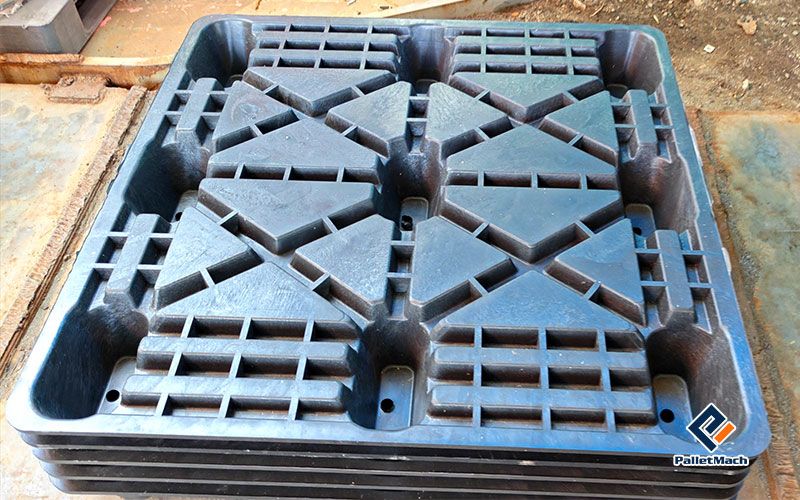
Here is the sequence, photographed at our customer’s plant in Japan — the material you have today, the line running, and what comes off it: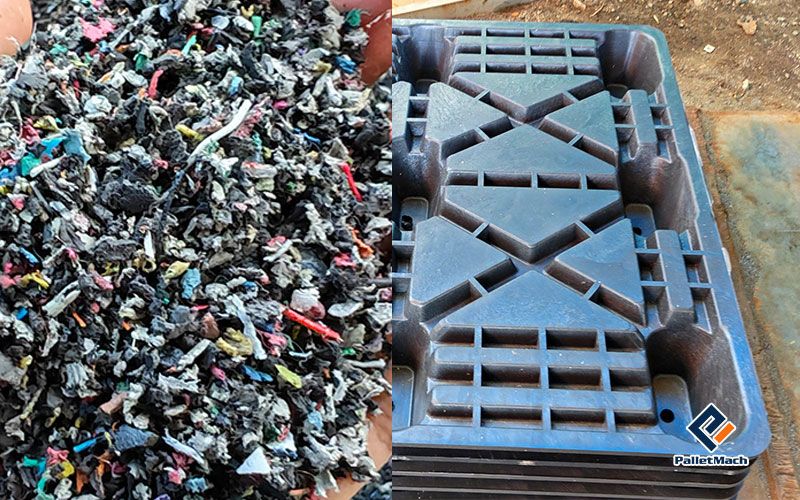
6. Where this works — including island and coastal markets
The economics bite hardest in developed markets, where disposal is charged for and where, from 21 November 2026, plastic waste can no longer be exported from the EU to non-OECD countries. When you cannot ship the skin out, you must process it where it is generated.
But the self-supply logic is not limited to one region. Anywhere a plant pays to remove waste and pays again to buy pallets, the case exists — and it is strongest where imports are expensive and land is scarce. Plants evaluating a plastic pallet machine in Sri Lanka, in Australia, in New Zealand or across the Pacific ask the same three questions we answer for every project: what is your waste stream, what pallet does it need to make, and who will run the line?
7. The part the machine alone will not solve
Cable skin pressed on its own gives a pallet that is soft and sags under load. The fix is formulation: blending PP/PE waste at 40–50% of the finished pallet weight, which delivers rigidity, load-bearing capacity and dimensional stability. That ratio is set by test, not by catalogue.
This is why our order of work is fixed: sample first, report second, quotation third. Equipment is the easy half of the project. The formulation, the process parameters and the operator training are what make a line work in month three, not just on commissioning day.
8. Frequently asked questions
I produce cable skin but it is not clean. Can I still press it into pallets?
Yes, and that is exactly why compression moulding suits this stream. The compound is melted and pressed, not injected through a fine nozzle, so there is no pelletising die to protect and no granulate grade to hit. Mixed PVC/XLPE material with fibre and traces of copper goes into the mould as it is. The blend still has to be set by test on your own material.
How much plastic do I have to add to cable skin?
You need to send pictures of the raw materials and the proportion of the raw material content and our engineers will provide you with a solution. The right figure comes from your own sample.
Do I need to pelletise the skin first?
No. It is worth drawing the distinction clearly: a plastic pallets mould injection machine needs granulated, cleaned, sorted resin and therefore needs washing, sorting and pelletising upstream. PalletMach’s line takes the crushed and blended material straight through the extruder into the mould. If your feedstock is a mixed, partly contaminated stream, removing the pelletising stage removes most of the cost.
Can the same line press other plastic waste?
The line is configured around your feedstock. Cable skin is the most common input for this application, but the same principle applies to other mixed plastic streams a plant already pays to dispose of. Send a sample and we will tell you honestly what it can and cannot do.
9. Start with a sample, not a quotation
- Tell us your cable type, monthly tonnage, and what you pay today to have the skin removed.
- Send us a sample of the skin, plus the PP/PE waste you have available on site.
- We run it and send a test report with the blend and the pallet result.
- Then we discuss the line.
The material is already in your yard. The pallets are already on your purchase order. The only open question is whether you keep both.
Send us your cable skin. We will press it and send the report.
Equipment for the production of plastic pallets is configured around your feedstock, your building and your pallet specification — not around a catalogue number.
Email [email protected]
Mobile / WhatsApp +86-13733828553
Website www.palletmach.com
Products
-
 Wood Pallet Machine
-
 Plastic Pallet Machine
-
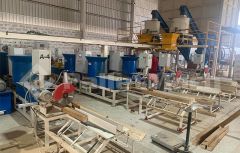 Pallet Block Machine
-
 Auxiliary Equipment