Cotton Stalk to Pallets-Client Visit to Test Fibre Pallet Machine
Xinjiang Cotton Stalk Client Visits PalletMach Equipment to Test Fibre Pallet Machine
Cotton stalk is one of China's largest unused fibre resources. We ran it on our press.
In September 2026 , Three client from Xinjiang's cotton belt arrived at the PalletMach plant with bales of cotton stalk and a single question: can this become an export-grade pallet?
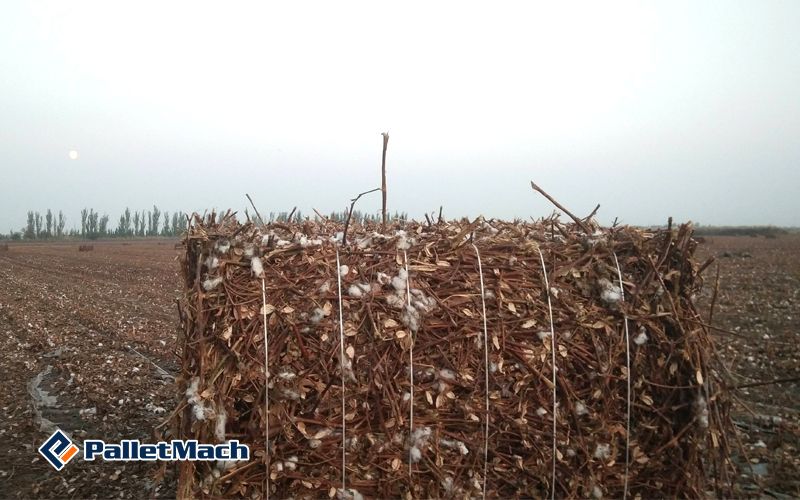
Xinjiang is China's largest cotton-producing region, and one county alone — Shaya — keeps about 1.7 million mu under cotton. Every harvest leaves behind a woody stalk with very few places to go. Returning it to the field is slow, burning it is restricted, and feeding it to livestock only works in small volumes because the fibre is tough and the lignin content is high.
That is starting to change. Several Xinjiang panel plants now buy cotton stalk as board feedstock at publicly reported prices of around RMB 220–230 per tonne — proof that a market for the material exists. What the material did not have was a route into pallets. That is what this visit was about.
What the Client Saw on the Factory Floor
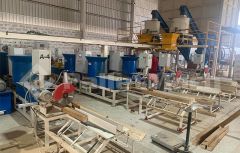
The visit followed our standard evaluation route. Accompanied by the PalletMach sales and engineering teams, the client toured:
- the equipment workshop, where the press bodies are assembled;
- the mould processing area, where pallet moulds are machined and finished;
- the finished pallet display section, where sample pallets are stacked and load-tested.
The client's questions were specific. They wanted to know how evenly the machine could press a material that arrives from the field with soil, roots and varying moisture — and whether the finished pallet would hold dimensions across a long production run.
Running Cotton Stalk Through a Presswood Pallet Machine
The trial was run on our presswood pallet machine line, using the client's own material rather than a prepared sample. The process follows the same principle as every fibre feedstock we handle:
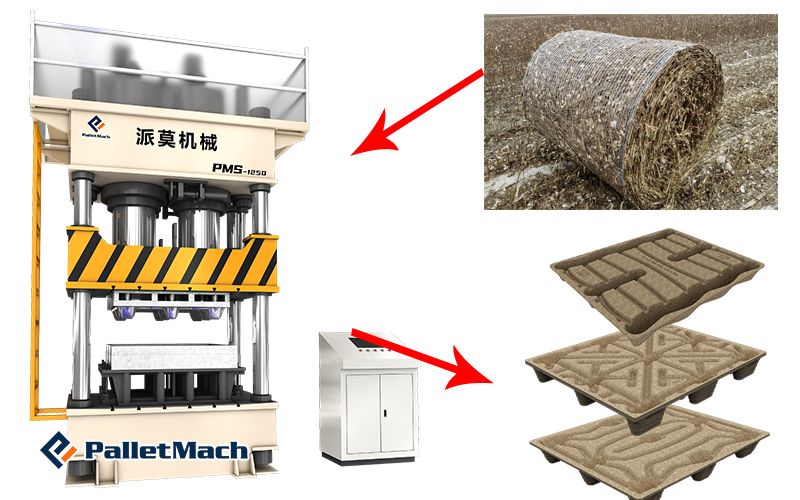 The most important factors are the humidity of the cotton stalks, the particle size after crushing, and the glue ratio
Cotton stalk has a high fibre content and a low bulk density, so the ratio has to be set for the material rather than copied from a wood-waste line.
Moisture, temperature and pressure
Material is dried to a controlled moisture range, then pressed at high temperature under hydraulic pressure. The combination does two things at once: it cures the adhesive and it eliminates pests and eggs, which is what allows the finished pallet to ship without fumigation.
Adhesive selection
We work with Wanhua Chemical and use modified MDI adhesive. Under high temperature and pressure it forms a cross-linked structure with a waterproof film and a three-dimensional fibre network, which is what carries the water-resistance and impact performance of the finished pallet.
Is Cotton Stalk a Proven Pallet Feedstock?
We will be direct about this. Cotton stalk is not on our published raw-material list — that list covers waste wood, sawdust, shavings, wood chips, straw, waste kraft paper, bamboo, palm trees, coconut fibre, bagasse and miscanthus.
Cotton stalk sits in the same family as the straw, bagasse and miscanthus we already run: high fibre, low bulk density, and a wide moisture range straight from the field. That is exactly the category where a fibre pallet machine proves its worth — and exactly why the client asked for a trial instead of a quotation.
From Trial to a Complete Fibre Pallet Machine Line
A test result is not a business. What the client left with was the outline of a delivered line: an assessment of their stalk supply and seasonality, a machine model sized to their pallet dimensions and target output, mould design, pre-delivery pressing tests, shipping, on-site installation and commissioning, operator training, and support until the first qualified pallet comes off the press.
One contract, one engineering team, one installation team. That is what a compressed wood pallet machine project looks like when it is handed over rather than simply sold.
Why Cotton Stalk Makes Commercial Sense
The economics rest on one point. A material that must be taken away, stored and disposed of is a cost. The same material, pressed into a pallet, becomes a product with an established export market — the finished pallet is ISPM 15 compliant and fumigation-free, suitable for direct export and for high-humidity and cold-storage conditions.
For a cotton region, that changes the shape of the problem. Stalk stops being a disposal line item and starts being a raw material with a floor price you already know.
Planning a Line Around an Unusual Material?
If you have a fibre feedstock that nobody has found a use for yet, the useful first step is a trial, not a catalogue. Send us a sample description and your pallet specification, and our engineers will tell you honestly whether a presswood pallet machine — or one of our molded wood pallet machine models — fits your material, your capacity target and your market.
its your material, your capacity target and your market.Contact PalletMach Equipment
Website: www.palletmach.com
Email: [email protected] WhatsApp: +86 137 3382 8553
Products
-
 Wood Pallet Machine
-
 Plastic Pallet Machine
-
 Pallet Block Machine
-
 Auxiliary Equipment