Kazakhstan Plywood Mill Visits PalletMach to Repurpose Waste Veneer & Peeler Cores Into ISPM 15 Presswood Pallets
Kazakhstan Plywood Mill Client Visits PalletMach to Turn Waste Veneer and Peeler Cores into Presswood Pallets
A plywood mill rejects logs for knots, bends, cracks and decay. We ran that stream as pallets.
In July 2026, a plywood manufacturer from Kazakhstan visited the PalletMach plant with samples of its own production waste: waste veneer trimmed off during peeling, the dust collected under the peeler, the peeler cores left after each log is rounded, and offcuts too small to feed back into board production.
Plywood manufacturing produces a continuous by-product stream before a single sheet is sold. Most mills have had two outlets for it — sell it cheaply as fuel chips, or pay to have it taken away. In Kazakhstan both are narrowing: the Ecological Code ranks landfill last in the waste hierarchy, and exports of wood chips and sawdust have been banned since December 2025.
This mill already knows the fuel route from the inside: its peeler cores are pressed into biomass pellets on site and sold as fuel. That line works, but it sells into an energy market where the price is set by heating value and nothing about the product can be differentiated. That is why the client came looking for a higher-value product built on the same residue — not a bigger pellet press.
The question was therefore not how to get rid of the residue, but what profitable project could be built on it — and whether the answer could be verified on their own material rather than on a supplier's sample.
What the Client Inspected
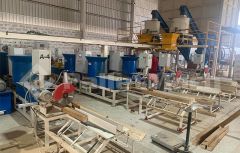
Accompanied by the PalletMach sales and engineering teams, the client toured the equipment workshop, the mould processing area and the finished pallet display section. Their focus was practical rather than technical: how much preparation the residue needs before it can be fed to a wood sawdust pallet machine, and whether pallet quality stays consistent when the incoming material changes from week to week.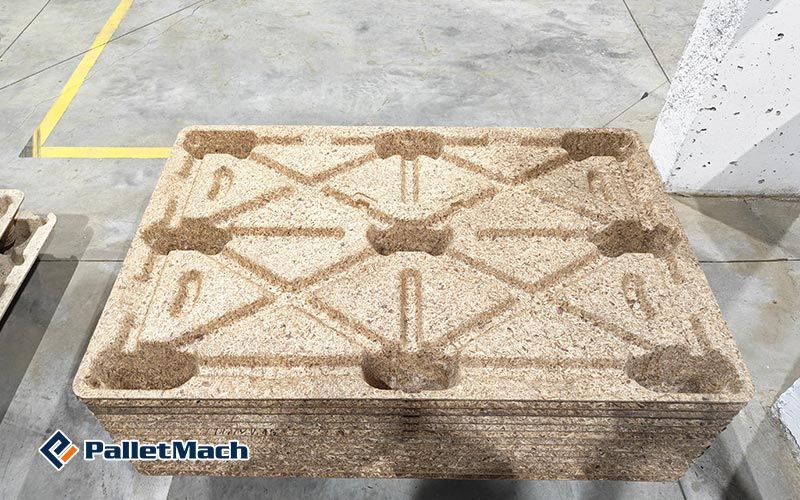
They also checked surface finish, edge density and rib uniformity on finished pallets.
Running Plywood Waste Through a Wood Sawdust Pallet Machine
The trial followed the same sequence we use for every wood-waste project, with the client's own material:
- Crushing — offcuts and rejected veneer are broken down to a workable chip size.
- Metal removal — a mandatory step. Fasteners, staples and stray metal damage moulds, and a damaged mould costs far more than the separation equipment.
- Fine pulverising to 2 mm — the particle size that allows even glue distribution and consistent density across the mould.
- Drying to a controlled moisture range — typically 10–15%, measured rather than assumed, because plywood residues carry very different moisture depending on storage.
- Gluing and pressing — high temperature under hydraulic pressure, using modified MDI adhesive.
Chip Proportioning Decides the Pallet
A common misconception is that any waste wood will produce a qualified pallet on any wood sawdust pallet machine. In practice the waste material is only the base feedstock — final performance is decided by chip proportioning and gluing. A balanced blend of coarse and fine particles is what delivers a pallet that resists compression and does not absorb water or crack: large chips behave like reinforcing steel, forming the load-bearing skeleton, while fine particles behave like cement, filling internal voids to raise density and reduce water swelling.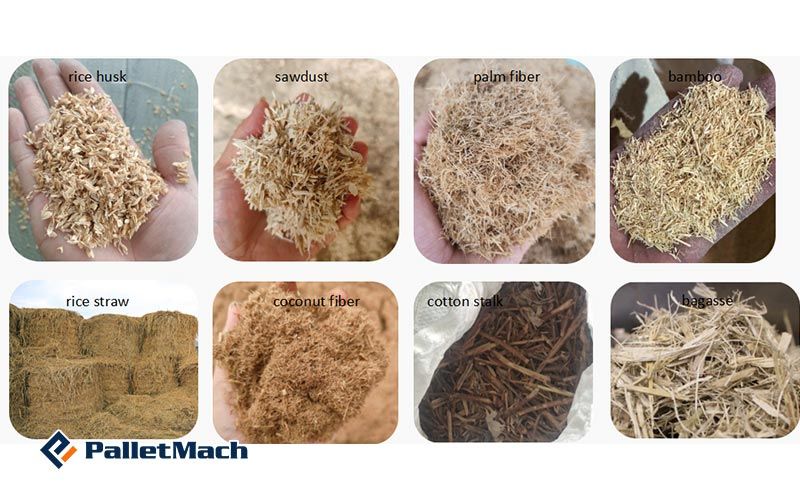
Plywood residues are especially variable — thin waste veneer behaves quite differently from the fine dust under the peeler, and peeler cores are denser and wetter again, because they are solid wood rather than a peeled sheet. Cores are normally crushed and blended with the lighter fractions rather than run alone. Our line adjusts chip-size ratios to the incoming material, which stabilises performance and cuts the defect rate at source.
Gluing is the other half. We work with Wanhua Chemical modified MDI adhesive; under heat and pressure it forms a cross-linked structure with a waterproof protective film and a three-dimensional fibre network, which lifts water resistance and impact performance well beyond what untreated wood waste achieves.
ISPM 15: The Export Argument
Pressed at high temperature under thousands of tonnes of pressure, pests and eggs are fully eliminated in the moulding process itself. The finished pallet meets the ISPM 15 standard and is fumigation-free for direct export — saving quarantine cost and, more importantly, waiting time at destination.
Load figures are worth stating plainly: dynamic load up to 1.5 tonnes, static load up to 6 tonnes, which suits high-humidity and cold-storage conditions. A stack of 20 pallets occupies just 0.75 m of height, saving around 70% of storage and shipping space against conventional wooden pallets.
The Regulatory Direction, Briefly
Kazakhstan's waste rules are moving in one direction, and the detail is public. The Ecological Code ranks disposal last in the waste hierarchy. Thermal treatment is permitted only after sorting and recycling, and the Ministry of Ecology confirmed in August 2026 that the country has no operating incineration plants. Wood chips and sawdust have been barred from export since 12 December 2025 — a ban extended in June 2026 — with Kazakh-origin wood pellets the only relevant exemption. Nationally, the 2030 targets are 40% recycling for municipal waste and 50% for industrial waste.
For a mill, the practical reading is narrow: residue can no longer be disposed of cheaply or shipped out as raw chips. Whether a pallet line makes sense on top of that is a business question, not a legal one — presswood pallets are priced as export packaging rather than as fuel, and the pallet buyer sits in the export chain the mill already serves.
Read the primary sources:
- Ecological Code of the Republic of Kazakhstan No. 400-VI — full text, English (waste hierarchy and permit limits)
- Ministry of Ecology: no operating incineration plants, waste-to-energy only after sorting (August 2026)
- Wood export ban extended for a further six months (June 2026)
- Government Council for the Green Economy — 2030 recycling targets (July 2026)
From Test Result to a Complete Compressed Wood Pallet Production Line
What the client took away was a full picture of delivery, not just a test report: residue assessment, machine sizing, mould design, pre-delivery pressing tests on their own material, shipping, installation, commissioning and operator training.
That is the difference between buying a sawdust pallet machine and commissioning a compressed wood pallet production line. One contract, one engineering team, one installation team, one point of accountability.
Have a Residue Stream You Are Already Paying to Handle?
If your plant produces waste veneer, peeler cores or offcuts that currently cost money to remove — or that you can only move as fuel chips or pellets, priced by heating value — a material trial is the fastest way to find out what they are worth as pallets. Send us a sample description and your target pallet specification, and our engineers will tell you candidly whether a wood sawdust pallet machine, an automatic hydraulic pallet machine or a fumigation free pallet making machine line is the right fit — and what it would cost to run.
Contact PalletMach Equipment
Website: www.palletmach.com
Email: [email protected] WhatsApp: +86 137 3382 8553
Products
-
 Wood Pallet Machine
-
 Plastic Pallet Machine
-
 Pallet Block Machine
-
 Auxiliary Equipment